Electrochemical CO2 Reduction on a Bi–Sn Eutectic Alloy in Acidic Media for Formic Acid Production
Avni Guruji, Alejandro Cañete-Arché, Yuvraj Y. Birdja, Ranjith Prasannachandran, Max García-Melchor, Deepak Pant
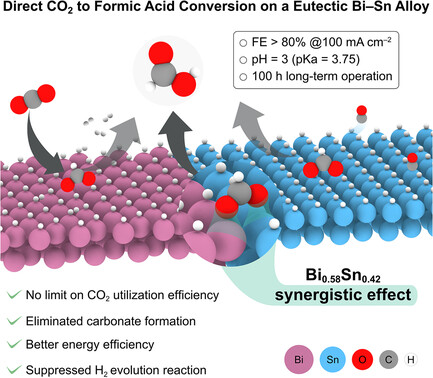
Electrochemical CO2 reduction (eCO2R) offers a sustainable route for carbon utilization, but most electrolyzers operate in neutral or alkaline media, where (bi)carbonate formation limits long-term operation and complicates product recovery. Here, we show that operating eCO2R under acidic conditions enables direct formic acid production while minimizing (bi)carbonate accumulation. A eutectic Bi–Sn gas-diffusion electrode (GDE) achieved a faradaic efficiency (FE) of 81.3% toward formic acid at −100 mA cm−2 and in a pH 3 electrolyte, outperforming Bi and Sn GDEs, with formic acid remaining the dominant product up to −400 mA cm−2. Density functional theory calculations revealed a synergistic Bi–Sn interfacial effect, where weakened hydrogen adsorption and intermediate binding of CO2-to-formate intermediates collectively suppress hydrogen evolution and promote formic acid formation. The GDE maintained stable performance with <10% FE loss in a 100 h continuous operation, using a periodic electrolyte replacement strategy. These results establish acidic eCO2R as a viable strategy for high-purity formic acid production and demonstrate how interfacial alloy engineering can advance CO2 electrolysis toward scalable, renewable energy-powered chemical manufacturing.